

How to Build a High Efficiency EV Station
High efficiency EV charging stations rely on precise power control, low energy loss, and stable operation under heavy load. As electric vehicles demand faster charging times, station design must support higher power levels without increasing heat generation or system strain. The core of this performance lies in power conversion systems, where magnetic components play a central role in managing voltage, current, and electromagnetic behavior. Selecting the right magnetic materials and designs directly affects charging speed, energy consumption, and system reliability. A well-structured EV station integrates these elements from the ground up, supporting consistent performance across continuous charging cycles.
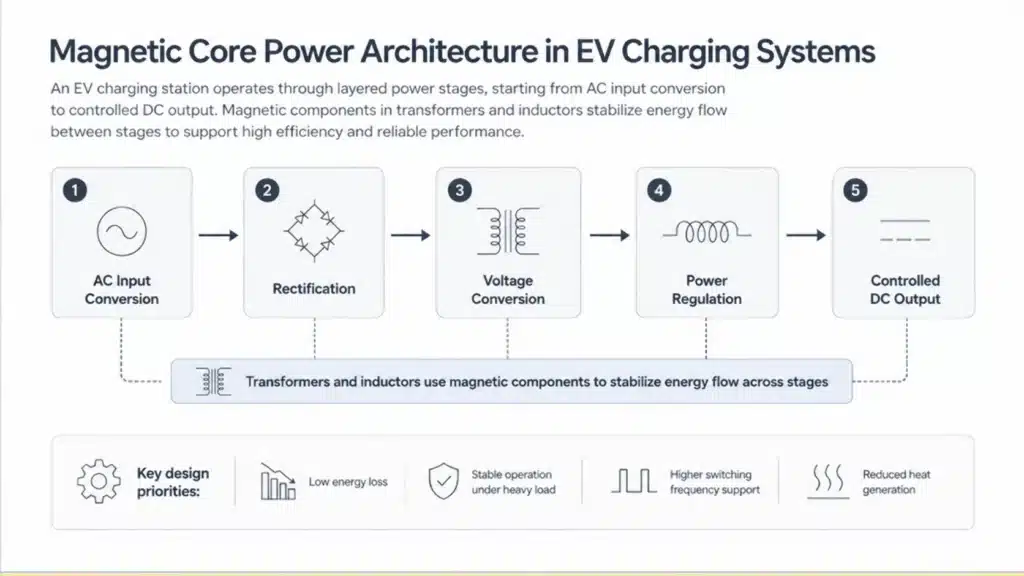
Core Power Architecture in EV Charging Systems
An EV charging station operates through layered power stages, starting from AC input conversion to controlled DC output. Each stage handles specific tasks such as rectification, voltage conversion, and power regulation. Magnetic components are embedded within transformers and inductors to stabilize energy flow between these stages. At higher power levels, heat and switching losses become more significant, making magnetic performance a key factor in maintaining steady output. Proper selection of core geometry and material helps support higher switching frequencies used in fast-charging systems.
Magnetic Cores for EV Charging
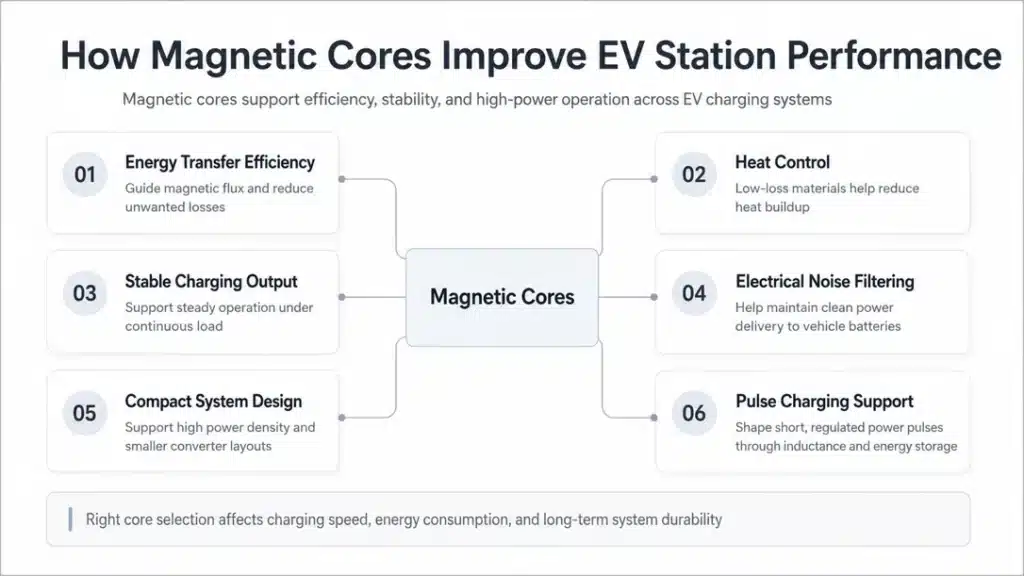
Magnetic Cores for EV Charging are central to managing energy transfer efficiency. These cores function inside transformers and inductors, guiding magnetic flux while reducing unwanted losses. In high-power EV chargers, low-loss materials such as nanocrystalline and amorphous alloys help reduce heat buildup during operation. This supports faster energy transfer and improves system stability under continuous load. Magnetic cores also assist in filtering electrical noise, which helps maintain clean power delivery to vehicle batteries. Their performance directly influences charging speed and long-term system durability.
Magnetic Cores in EV Stations
Magnetic Cores in EV Stations are used across multiple system levels, from grid connection transformers to final DC charging modules. At the station level, they support load balancing between multiple charging points and help manage fluctuations in incoming power. Fast-charging stations, particularly those above 150 kW, rely heavily on magnetic components to handle rapid energy conversion without instability. Core design also affects physical system size, allowing compact station layouts while still handling high power density. This makes installation and expansion more practical for operators scaling charging networks.
High-Frequency Conversion and System Performance
Modern EV stations increasingly operate at higher switching frequencies to reduce component size and improve energy efficiency. This shift places greater demand on magnetic materials that can handle rapid flux changes without excessive loss. Proper core selection reduces heat generation and supports compact converter designs. System designers focus on balancing frequency, efficiency, and thermal limits to maintain steady charging output. This stage directly affects station uptime and operating cost, especially in high-traffic charging locations where continuous usage is expected.
Magnetic core Pulse Charging
Magnetic core Pulse Charging introduces controlled energy delivery through short, regulated power pulses instead of continuous flow. Magnetic cores help shape these pulses by controlling inductance and energy storage within the charging circuit. This method reduces stress on battery cells, limits heat buildup, and supports more stable charging cycles. It also improves power conversion efficiency during high-demand charging sessions. Pulse-based charging systems benefit from carefully engineered magnetic cores that respond quickly to changing current levels, making them suitable for next-generation fast-charging infrastructure.
Power Up Your EV Station Without Losing Efficiency in the Process
High-performance EV charging starts with smarter power design. If your system needs faster charging, lower losses, and better stability under heavy load, the right magnetic core selection makes the difference. Get in touch to discuss magnetic core solutions for EV charging stations built for real-world demand, not just lab conditions.
 Print This Page