

Pulse Energy in Magnetic Cores
Pulse energy in magnetic cores describes how electromagnetic energy is stored, transferred, and regulated within magnetic materials during rapid electrical switching. Instead of continuous current flow, modern power systems rely on controlled energy pulses. These pulses interact directly with magnetic components, making core behavior essential to efficiency, stability, and thermal performance.
In Pulse Charging Systems, energy is delivered in short, controlled bursts rather than a steady flow. This improves energy management in high-frequency applications but also increases the demand placed on magnetic cores, which must repeatedly store and release energy without excessive loss.
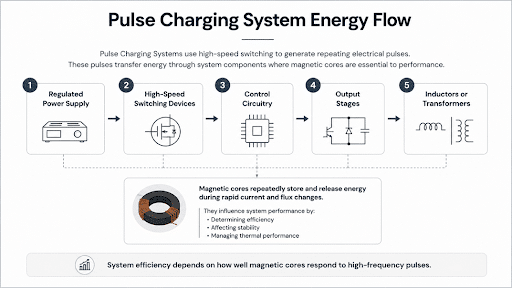
Pulse Charging Systems and Energy Flow
Pulse Charging Systems operate using high-speed switching that generates repeating electrical pulses. These pulses are directed into loads, storage systems, or conversion stages. While the external operation appears simple, internal energy behavior is strongly dependent on magnetic components.
A typical system consists of:
- A regulated power supply
- High-speed switching devices
- Control circuitry for timing, frequency, and duty cycle
- Output stages connected to inductors or transformers
These components must operate in precise coordination. However, system efficiency ultimately depends on how well magnetic cores respond to rapid changes in current and magnetic flux.
As switching frequencies increase, energy transfer becomes more sensitive to losses, timing variations, and heat buildup, making magnetic core performance a limiting factor in advanced designs.
Magnetic Core Pulse Charging and Energy Behavior
Magnetic core Pulse Charging focuses on how magnetic materials behave under repeated high-frequency excitation. During each pulse cycle, magnetic cores store energy in their magnetic field and release it as the cycle transitions.
Core behavior directly affects system efficiency. Poorly designed or mismatched materials introduce losses through:
- Hysteresis
- Eddy currents
- Thermal dissipation
These losses reduce efficiency and can impact long-term system reliability. As a result, material selection and core geometry are critical design parameters.
Magnetic cores also help reduce electromagnetic interference caused by fast switching. By stabilizing flux transitions, they smooth waveform behavior and improve signal quality across the system.
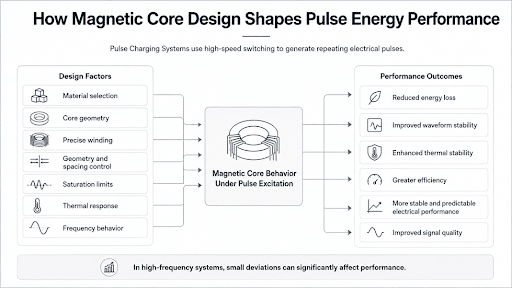
Pulse Charging Manufacturing and Design Control
Pulse Charging Manufacturing requires precise coordination between electrical design, magnetic materials, and mechanical construction. It is not a simple assembly process but a controlled engineering workflow where small deviations can significantly affect performance.
Key design priorities include material selection for high-frequency operation, precise winding of inductors and transformers, and strict control of geometry and spacing. These factors determine how efficiently pulse energy is transferred through the magnetic structure.
Testing under real operating conditions is essential to confirm stability, efficiency, and thermal behavior before deployment in demanding applications.
Applications of Pulse Energy in Magnetic Core Systems
Pulse energy in magnetic cores is used in systems where controlled energy delivery and efficiency are critical. Applications include industrial charging systems, electric vehicle infrastructure, renewable energy conversion, aerospace power systems, and medical imaging equipment.
Key benefits across these applications include:
- Improved energy regulation under variable load conditions
- Greater efficiency in high-frequency conversion stages
- More stable and predictable electrical performance
Each of these environments depends on precise control of energy flow, which is directly influenced by magnetic core design.
Engineering Perspective
From an engineering standpoint, magnetic core behavior under pulse excitation is a key factor in system design. Engineers evaluate material properties, saturation limits, thermal response, and frequency behavior to ensure stable performance.
When properly engineered, magnetic cores reduce energy loss, improve waveform stability, and enhance overall system efficiency. This makes them essential in Pulse Charging Manufacturing, Magnetic core Pulse Charging, and modern Pulse Charging Systems, where performance depends on precise control of high-frequency energy flow.
Don’t Let Your Pulses Miss a Beat
If your system depends on precision, your magnetic cores should too. Let MK Magnetics, Inc. help you turn controlled pulse energy into consistent performance because in high-frequency systems, even a small ripple can cause a big problem. Connect with MK Magnetics, Inc. today and engineer your next Pulse Charging System with confidence.
 Print This Page